 China Martial Arts Supplier & Manufacturer of Sports Protective Products | Tidesports
You might already know that Martial Arts Mats are one of the most profitable items to sell…
But they are also the most dangerous to ship.
Why? Because when you import bulky, lightweight foam, you are essentially paying to ship “air.”
As a B2B buyer, I know that looking at a low “Factory Price” is tempting. But the real number that destroys margins is the Landed Cost.
In this post, you’re going to learn exactly how to navigate The Hidden Cost of Importing Martial Arts Mats.
I’m going to share the specific logistics strategies we use at Tidesports, from Maximizing Container Load to leveraging our 7km proximity to Qingdao Port.
This is the blueprint to stop wasting space, optimize your CBM, and finally Save Freight.
Let’s dive right in.
Deconstructing the Hidden Costs of Logistics
Ever looked at a freight invoice and felt like you were paying to ship air? When you are in the business of selling flooring, The Hidden Cost of Importing Martial Arts Mats usually isn’t the manufacturing price—it’s the logistics. I’ve seen too many gym owners and wholesalers burn their margins because they focused solely on the unit price and ignored the landed cost.
Here is the reality: Logistics is where your profit lives or dies. Let\’s break down where the money actually goes.
Volumetric Weight vs. Actual Weight
Carriers are smart. They don’t just charge based on how heavy your pallet is; they charge based on how much space it steals from the ship. This is the battle of Volumetric Weight vs. Actual Weight.
Since EVA foam mat density is relatively low compared to steel or electronics, your shipment is light but bulky.
- Actual Weight: The physical weight of the mats (Light).
- Volumetric Weight: Length x Width x Height / Dim Factor (Heavy).
If the volumetric weight is higher (and with mats, it almost always is), that is what you pay. You need to master volumetric weight calculation before you place an order, or you will be shocked when the freight bill arrives.
The LCL Trap: Avoiding Financial Mistakes
If you are just starting out, you might be tempted to ship a few pallets via LCL (Less-than-Container Load). Don\’t do it.
For high-density, small items, LCL works. For bulky Tatami or interlocking mats, it is a financial trap.
- Per CBM Costs: LCL freight rates per cubic meter are significantly higher than FCL.
- Handling Fees: You pay extra for the warehouse to consolidate and deconsolidate your goods.
- Damage Risk: Your soft mats are sharing a container with heavy machinery or liquids from other shippers.
When comparing FCL vs LCL shipping for flooring, FCL (Full Container Load) is almost always the only way to stay competitive.
Inland Freight: The Silent Profit Killer
Most people use a landed cost calculator and stop at the destination port. That’s a mistake. Inland freight—the cost of trucking the container from the port to your warehouse—is skyrocketing.
If your warehouse is 500 miles from the port, that trucking fee can sometimes cost as much as the ocean freight itself. Always factor in the \”last mile\” delivery when negotiating your terms.
Customs & HS Codes: Classification Matters
Getting your goods through customs requires the correct paperwork. The HS Code for sports equipment determines your duty rate.
- Wrong Code: You might overpay on import duties and tariffs (e.g., classifying mats as \”textiles\” instead of \”rubber/plastics\” or \”sports goods\”).
- Audits: Misclassification can lead to fines and delays.
Ensure your supplier provides the exact HS code used for martial arts equipment wholesale to avoid surprises at the border. Every percentage point saved on duty is a percentage point added to your bottom line.
Master Class: Maximizing Your Container Load (FCL)

Mixed container loading diagram: packing boxing gear with tatami mats to save freight
The Tetris of Tatami: 20ft vs 40ft HQ
When importing martial arts mats, you are fighting against volume, not weight. The \”hidden cost\” often lies in shipping empty space. For products with high volume like ours, a 40ft High Cube (HQ) container is almost always the superior choice over a standard 20ft container.
A 20ft container hits its cubic capacity limit long before it hits its weight limit. The 40ft HQ gives you that critical extra height, allowing us to stack Tatami mat dimensions (100cm x 100cm) higher and tighter. This significantly lowers the shipping cost per mat compared to smaller containers or FCL vs LCL shipping splits.
Nesting & Interlocking: Removing the Gaps
The unique design of interlocking floor mats bulk orders presents a specific challenge: the jigsaw edges. If thrown into a box randomly, those \”teeth\” create massive air gaps. We use a precise nesting strategy where mats are stacked so the interlocking edges align or offset perfectly within the packaging.
Whether we are packing professional dojo gear or a standard baby play mat, this technique ensures we aren\’t shipping air. Tighter packing means more units per pallet and better protection against deformation during transit.
Standardization vs. Custom Shapes
Sticking to standard sizes is one of the easiest ways to optimize your freight. Our manufacturing lines are calibrated for standard outputs which align with global shipping container dimensions:
| Mat Type | Standard Size | Container Fit |
|---|---|---|
| Professional Tatami | 100cm x 100cm | Excellent: Fits flush in rows with minimal side gaps. |
| Puzzle Mats | 60cm x 60cm | High: Easy to stack on standard pallets. |
| Custom Shapes | Variable | Poor: Creates \”dead zones\” and wasted CBM (Cubic Meters). |
The Density Factor: High-Density Efficiency
High-density foam manufacturing plays a surprising role in logistics. Low-density mats take up the exact same amount of space as high-density ones but offer significantly less durability and performance.
By sourcing our High-Density EVA or XPE foam mats, you maximize the value density of your container. You are paying the same freight rate for a container of mats, so it makes financial sense to fill it with heavier, professional-grade material rather than paying to ship low-quality foam that is mostly air bubbles.
The Fill the Gaps Strategy: Mixed Container Loading
Utilizing Wasted Space in Mat Containers
When importing bulky items like EVA foam mats, you are often fighting against volumetric weight. Even when a container looks full, the nature of stacking mats often leaves \”dead air\” that you are paying to ship. This is a critical inefficiency in freight forwarding strategies. We don\’t just manufacture; we act as your supply chain partner to identify these pockets of wasted space before the doors close.
Consolidation: Adding High-Value, Low-Volume Items
To combat the cost of shipping air, we implement mixed container loading. This involves consolidating your primary order of mats with smaller, denser products that fit easily into the gaps. Because we handle integrated sourcing, we can combine your mat order with high-value, low-volume gear.
For instance, placing cartons of a custom sports gumshield or martial arts uniforms into the remaining spaces of a 40HQ container utilizes volume that would otherwise be lost. This approach transforms a logistics burden into a strategic advantage.
The Math: How Mixed Loading Reduces Effective Freight Costs
The financial impact of supply chain consolidation is immediate. Since the cost of the container (FCL) remains relatively fixed regardless of the weight inside (up to the limit), adding more products lowers the shipping cost per unit.
- Fixed Cost: The price to ship the container from Qingdao to your port.
- Variable Value: The total value of goods inside.
- Result: By filling gaps with compact gear, you dilute the freight expense across a larger inventory, significantly lowering your landed cost per item.
Leveraging Warehousing to Time the Market
The Inventory Dilemma: Managing Stock vs Freight Rate Spikes
Balancing inventory levels against volatile shipping rates is one of the toughest challenges in the global sports supply chain. Importing martial arts mats requires precise timing; ordering too early can tie up capital, while ordering too late risks stockouts during peak season. Furthermore, ocean freight rates fluctuate wildly. Being forced to ship a container during a rate spike simply because your manufacturer lacks storage space destroys profit margins. You need the flexibility to hold production until rates stabilize.
10,000 m² Free Storage: Holding Stock Until FCL is Ready
We solve the logistics pressure by offering 10,000 m² of free storage at our Qingdao production base. This massive warehousing capacity allows us to act as your strategic partner rather than just a manufacturer. You can order production runs in advance and hold the finished goods in our facility without incurring extra fees.
This capability highlights the difference between factory-direct sourcing and trading companies, as many intermediaries lack the physical infrastructure to hold large-volume items like Tatami or EVA mats. We allow you to accumulate different batches of gear—mats, uniforms, and accessories—over time, keeping them safe and dry until you are ready to trigger the shipment.
Avoiding Half-Empty Container Shipments
The most expensive space in logistics is empty space. Shipping a container that is only 80% full means you are paying to transport air, which significantly increases the landed cost per mat. By leveraging our storage, you can wait until you have exactly enough product to achieve a 100% load factor.
We facilitate supply chain consolidation by holding your primary order of mats while you finalize smaller orders for high-density items to fill the remaining gaps. This ensures you never have to settle for a Less-than-Container Load (LCL) or a half-empty Full Container Load (FCL). Once your consolidated load is optimized for maximum volume, you can submit an inquiry to our team to finalize the booking and customs clearance.
Quality Control: The Ultimate Cost Saver
Many importers fixate solely on the initial unit price, but the real profit killer is poor quality. When you are shipping martial arts mats halfway across the world, you cannot afford to open the container and find unusable stock. Quality control isn\’t just about the product; it is the primary defense against logistical financial disasters.
The Cost of Returns: Why Replacements Are the Most Expensive Shipment
The most expensive shipment you will ever book is a replacement for defective goods. It is not just the cost of manufacturing the new batch; it is the freight, the import duties, and the local handling fees paid twice. Plus, you often face the disposal cost of the bad batch. This is the hidden cost of importing martial arts mats that destroys margins.
If you calculate your import EVA mats cost without factoring in the risk of returns, you are gambling. A strict QC process eliminates the risk of receiving mats with surface defects, color mismatches, or poor interlocking tabs, ensuring your landed cost calculator reflects reality, not a best-case scenario.
Pre-Shipment Inspection: 100% Batch Inspection Process
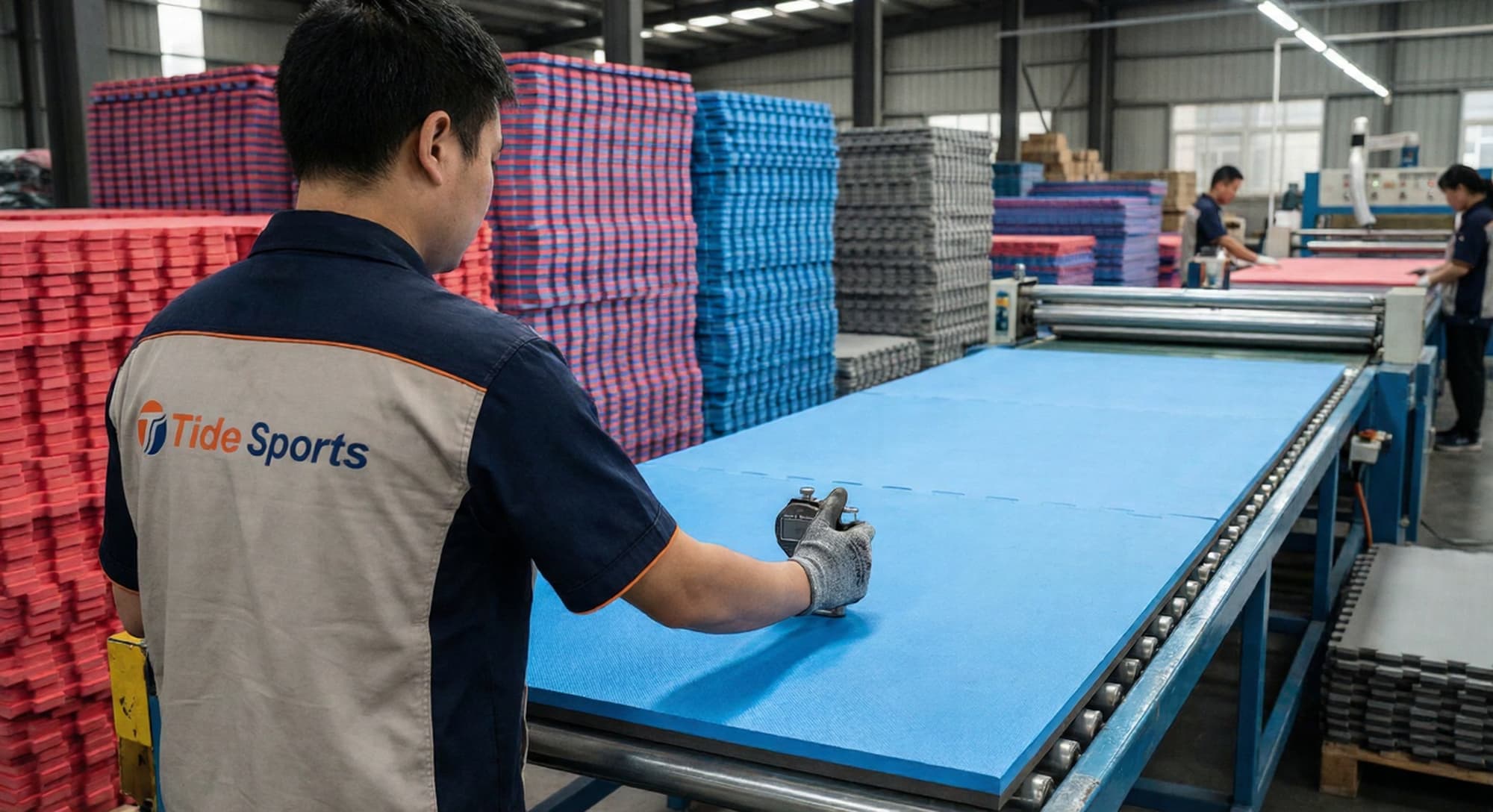
We do not rely on random sampling for our core products. In high-density foam manufacturing, consistency is everything. Our team conducts a 100% batch inspection process. We check the hardness (Shore C or A), color consistency, and thickness of every production run.
For example, with our 101cm interlocking EVA foam mats, we physically test the connection points to ensure they fit seamlessly before they are ever packed. This prevents the nightmare of customers receiving floors that do not lay flat or have gaps between the tiles.
Packaging Integrity: Preventing Moisture Damage and Deformation
The journey from Qingdao port logistics hubs to your warehouse involves high humidity, salt air, and temperature spikes. EVA foam and Tatami covers can be sensitive to these changes if not packed correctly. We prioritize packaging integrity to survive the voyage:
- Moisture Protection: We use heavy-duty plastic wrapping and desiccants to seal out sea air, preventing mold and water damage during transit.
- Structural Support: Proper stacking prevents deformation. Tatami mat container loading requires precise alignment so the bottom mats are not crushed by the weight of the top stack.
- Carton Strength: We use reinforced corners to stop edge damage during the rough handling typical in both FCL vs LCL shipping.

Factory worker performing pre-shipment quality inspection on high-density foam mats
Frequently Asked Questions About Importing Martial Arts Mats
What is the difference between FCL and LCL for mats?
FCL (Full Container Load) means you book the entire container, whereas LCL (Less-than-Container Load) involves sharing space with other shippers. For lightweight, bulky products like EVA or Tatami mats, FCL vs LCL shipping is a critical decision. LCL is often a financial trap for mats because freight forwarders charge based on volume (CBM), not just weight. You end up paying a premium for the \”air\” inside the foam. We almost always recommend maximizing a 40HQ container to ensure your per-mat shipping cost remains viable.
How does mat density affect shipping costs?
Shipping lines charge for space, so the physical dimensions (volume) of the mat determine the freight rate, regardless of density. However, high-density foam manufacturing plays a huge role in value. A professional high-density mat takes up the same CBM optimization space as a low-quality, low-density mat. By importing higher density specs, you are shipping durable, professional-grade gear for the same freight cost as cheap disposable mats, effectively maximizing the ROI of that container slot.
Can I mix different martial arts equipment in one container?
Absolutely, and this is our preferred strategy for mixed container loading. Since mats are high-volume but relatively light, we often have remaining weight capacity in the container. We use our 10,000m² warehouse to consolidate your order, filling the empty spaces between mat stacks with dense, high-value items like BJJ Gi uniforms or boxes of Judo belts. This approach utilizes \”dead space,\” meaning you essentially ship the accessories for free since the container volume was already paid for by the mats.
How do I calculate the landed cost of imported mats?
To find the true cost, you must look beyond the factory price. A basic landed cost calculator formula is: (Manufacturing Cost + Inland Freight + Ocean Freight + Insurance + Import Duties) / Total Units. Because TideSports is located just 7km from Qingdao Port, we significantly reduce the initial inland transport fees compared to inland factories. When you request a quote, we can help estimate these logistics costs so you have a clear picture of your total investment before the ship leaves the dock.