 China Martial Arts Supplier & Manufacturer of Sports Protective Products | Tidesports
Buying wholesale judo mats is a specification job before it is a price job. A mat that suits a karate class will bottom out under a competitive uchi-mata, so this guide covers the thickness, density and format dojos specify, and how the order runs from RFQ to container.
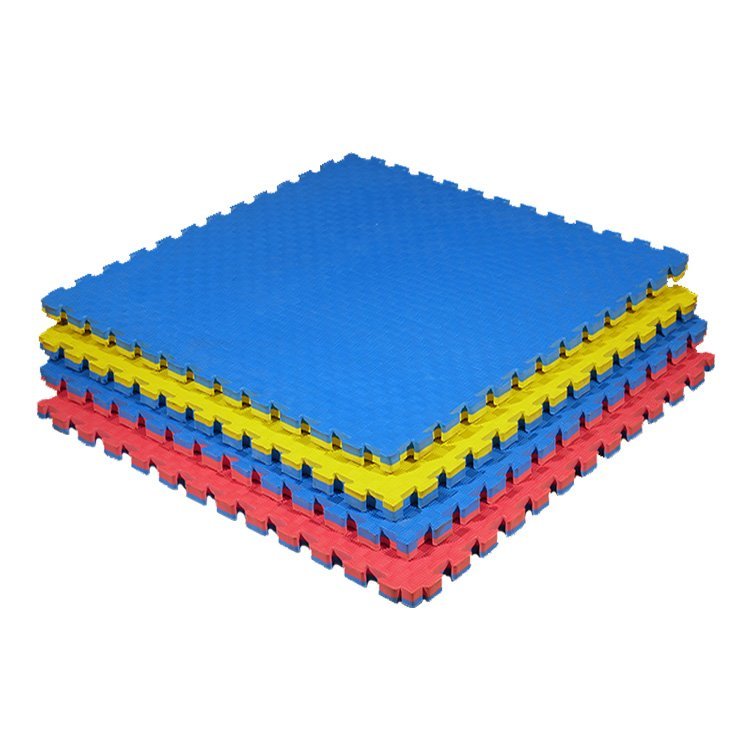
Where the season starts. Clubs renew flooring between seasons, so club demand follows the elite calendar.
Why Judo Mats Are Specified Differently From Striking Floors
The elite calendar sets the terms. The IJF World Judo Tour finished its championship block in Baku in October and closes the year at the World Judo Masters in December. A dojo training throwing technique needs absorption and recovery, not just a firm surface.
Dataintelo values the judo equipment market at about USD 2.8 billion in 2025, heading for USD 4.1 billion by 2034. Demand is not the constraint; the specification is.
Traditional tatami solved two problems at once: a woven surface for grip and a straw core for absorption. Modern wholesale judo mats keep the embossed top and swap the core for closed-cell EVA foam, so thickness and density carry that load.
What Wholesale Judo Mats Buyers Compare Before Price
Competition floors use 1 x 1 m or 1 x 2 m interlocking panels at 50 mm; club dojos commonly buy 40 mm. The real difference between a competition tatami and a training floor is density and rebound.
| Training group | Thickness | Panel format | Surface |
|---|---|---|---|
| Judo and grappling | 40-50 mm | 1 x 1 m or 1 x 2 m interlock | Tatami embossed |
| Karate and taekwondo | 20-30 mm | 1 x 1 m interlock | Tatami embossed |
| Weights corner | 20-30 mm | Rubber-top tile or roll | Wipe-down rubber |
| Kids and warm-up | 10-20 mm | 30-60 cm puzzle tile | Smooth or wood grain |
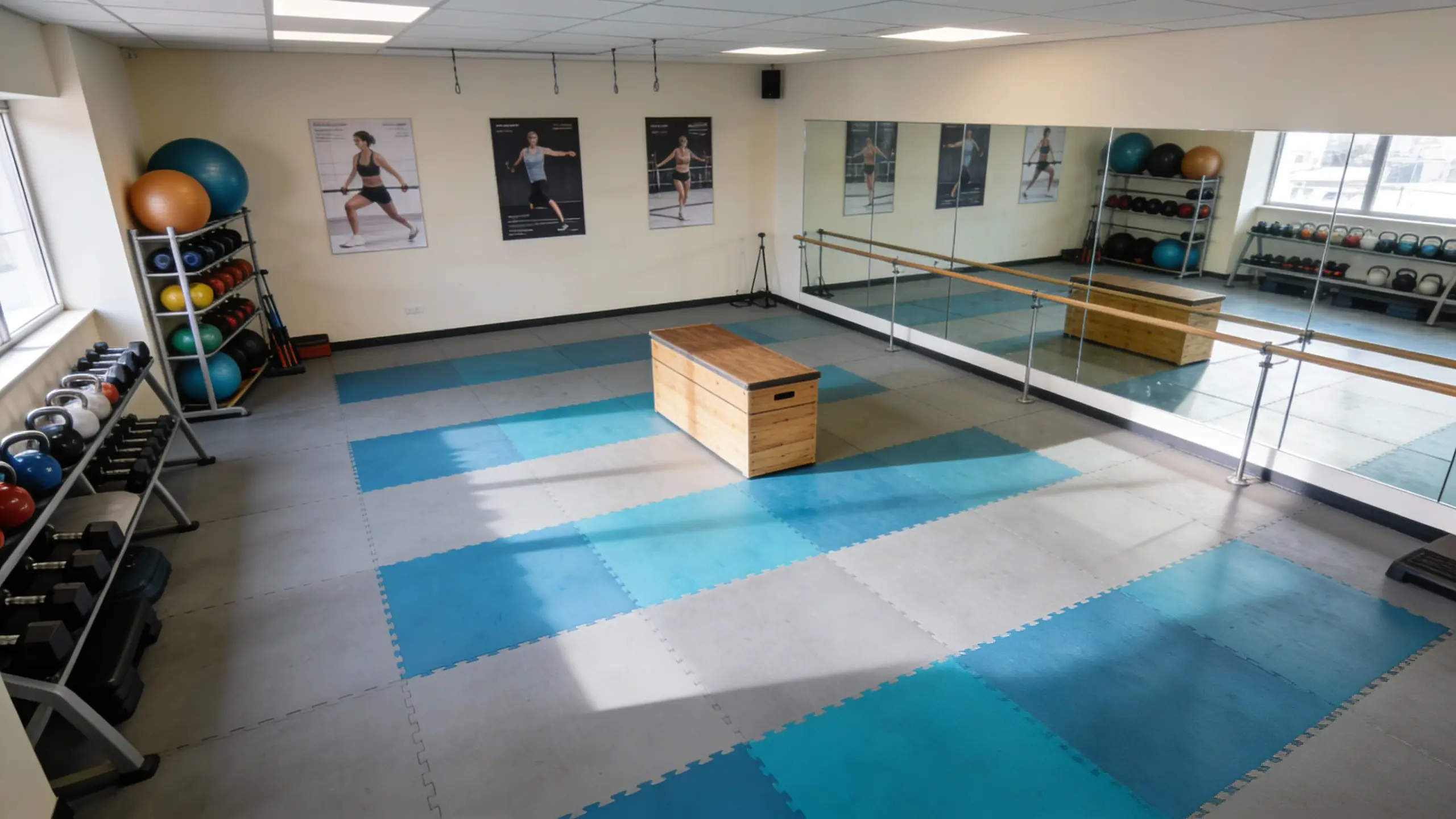
One room, two zones. Most dojos lay a 40 mm throwing area and a firmer strip along the bag wall.
Judo Dojo Floor Build-Up: What Sits Under the Tatami Surface
A judo floor is an assembly of four layers, and a weak one at the bottom surfaces as a seam inside a season.
Subfloor and barrier. Concrete or plywood flat within 3 mm over 2 m, with polyethylene film under a slab-on-grade dojo.
Absorption core. Mat-grade EVA at roughly 100-180 kg/m3, 40-50 mm for throwing floors, hardness quoted in Shore C.
Wear layer and edges. An embossed top for grip and a bevelled border ramp; compare an interlocking foam mat with a tatami mat panel before committing a dojo to either lock.
Specs to Fix in a Wholesale Judo Mats RFQ
Quotations for wholesale judo mats are only comparable when the sheet is identical. Fix these lines in writing before asking for a price.
Thickness and tolerance. Nominal 40 mm or 50 mm plus the tolerance band.
Density and hardness. Ask for kg/m3 rather than “high density”, plus Shore C and a rebound figure, so a reorder matches the first.
Surface and grip. Embossed tatami is standard, but ask how the grain treats skin during groundwork; a martial arts mat with a lighter grain suits mixed classes, and a wipe-down dual layer rubber top EVA foam top helps where the room doubles as a studio.
Compliance and colour. Phthalate-free foam, a test report for the destination market, and a written batch-consistency rule.
From RFQ to Container: How a Judo Mat Order Runs
A wholesale order has six stages and only one is a price conversation. The gate that matters is the sample: the last moment a wrong density costs a tile instead of a container.
Ask for dated photos of the production batch and a loading plan showing how the pallets sit in the box – the discipline in our importing martial arts mats guide.

One container, one plan. Mats are palletised at the door end, equipment cartons behind.
MOQ, Cartons and Container Loading for Wholesale Judo Mats
Stock colours and standard panels are quoted from a few hundred square metres, so a single-site dojo can buy at a distributor price; new moulds need a full run. Ask for carton size, gross weight, pallet height and panels per 20 ft container, and quote a phased refit in phases – throwing area first, then the wall strip, with lighter foam exercise mats or EVA puzzle mats for the warm-up corner.
Factory or Trading Company? Vetting a Judo Mat Supplier
Five checks tell you which side of the desk you are talking to: who owns the press, who compounds the foam, how fast a sample leaves the plant, and whether batch photos arrive before shipment. Ours presses mat-grade EVA and cuts cartons on one site in Qingdao, so stock colours ship in three weeks.
Clubs kitting out a building order flooring and uniforms together – a judo uniform, a BJJ uniform with BJJ belts, a wrestling dummy, or a karate uniform and taekwondo protector set – while a wood grain foam mat studio area or rubber gym floor mat weights corner rides the same shipment.
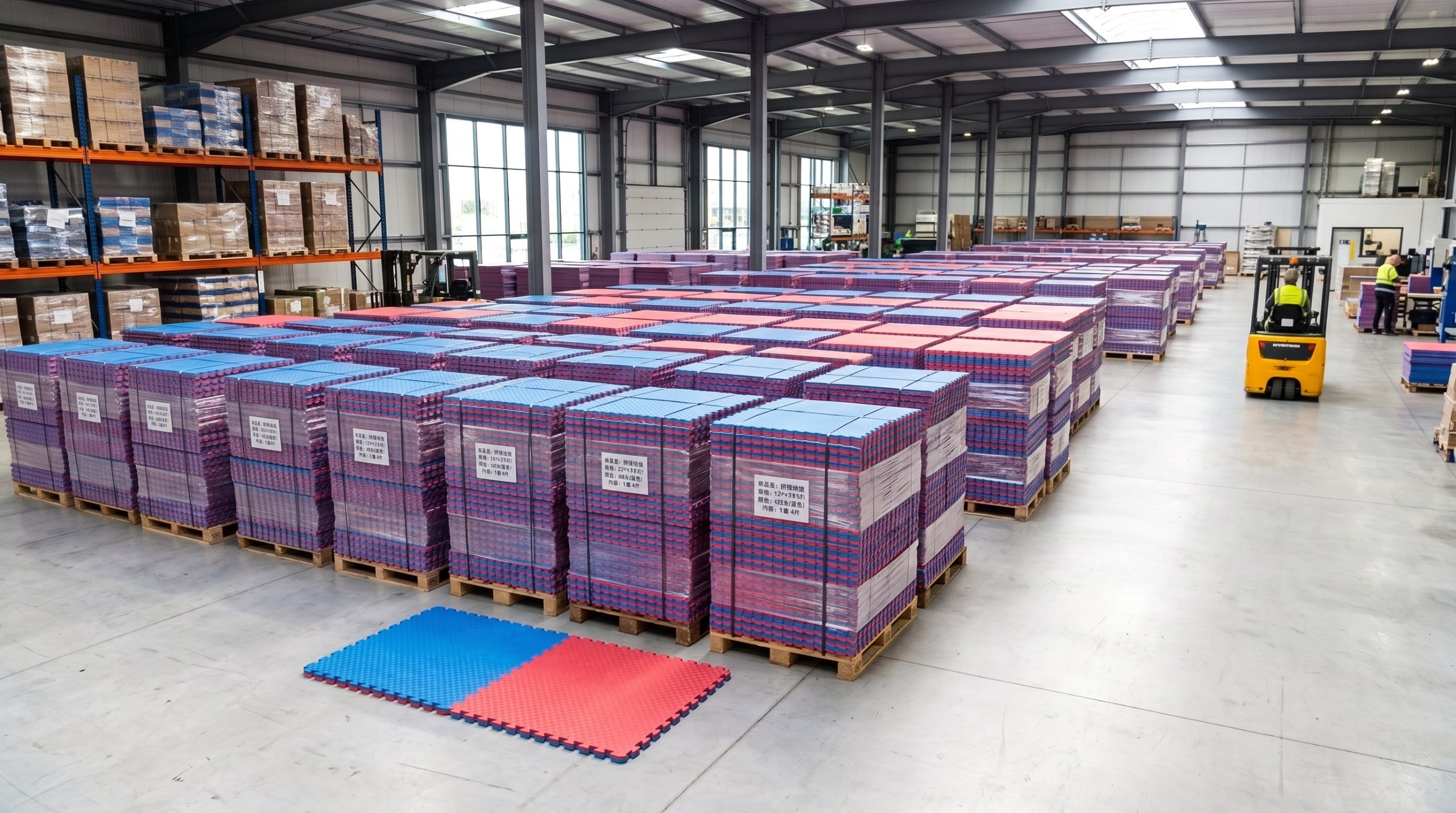
Stock depth decides your date. Standard competition colours ship with no mould-change queue.
FAQ: Sourcing Judo Mats in Bulk
What thickness do wholesale judo mats need to be?
Competition floors are built at 50 mm, club dojos specify 40 mm, and a firmer 25 mm strip is normal along the bag wall.
What is the MOQ for a judo mat order?
A few hundred square metres for stock colours; custom embossing or private-label cartons need a full run.
Can EVA tatami mats take competitive throws?
Yes, if the core is specified by density rather than thickness. Ask for kg/m3 and Shore C, and approve a sample first.
Do you supply competition-format panels in red and blue?
Yes – 1 x 1 m and 1 x 2 m interlocking panels in the standard dual-colour combinations.
Can mats and club equipment share one container?
Yes: mats are palletised at the door end and equipment cartons load behind them.
Wholesale pricing rewards buyers who arrive with a specification: fix the lines above and a wholesale judo mats comparison becomes arithmetic.
Free OEM/ODM consultation from Tide Sports, Qingdao – EVA tatami and martial arts flooring since 2016. Send your dojo layout for a factory price.